Can AI make me a debt payoff plan?
Half. AI explains the snowball and avalanche methods and lays out an order to pay your debts. Month-by-month interest math is where it slips, so check the numbers in a calculator.
01Why half-bot
- Choosing an order to pay debts is simple logic AI handles well.
- Interest compounding over many months is easy for a chat app to get wrong.
- A spreadsheet or payoff calculator checks the math for free.
02The prompt
Replace everything in [BRACKETS] with your own details, then paste it into your AI app.
Help me plan how to pay off my debts. You are a coach, not a financial advisor.

My debts (name, balance, interest rate, minimum payment): [LIST]
Total I can pay each month: [AMOUNT]

Give me:
1. The payoff order using the avalanche method (highest rate first) and the snowball method (smallest balance first), side by side.
2. How much extra goes to the first debt each month after all minimums are paid.
3. Which method saves more interest, and which gives faster early wins.
Rules: do NOT give exact payoff dates or total interest unless you show the full month-by-month math. Tell me to confirm numbers in a payoff calculator.
03Steps
- List every debt with its rate and minimum.
- Pick a method.
- Check the timeline in a free payoff calculator or spreadsheet before you commit.
04What can go wrong
- Wrong interest math can make a plan look faster than it is.
- If debt feels unmanageable, a nonprofit credit counselor can help.
05What to use
06Our test runs
2 runs, each with a different made-up sample. 1 of 2 passed every check.
The made-up sample:
[LIST]Credit Card A: $3,200 balance, 19.99% APR, $96 minimum; Credit Card B: $1,500 balance, 22.49% APR, $45 minimum; Personal Loan: $7,800 balance, 9.75% APR, $210 minimum; Auto Loan: $9,500 balance, 4.5% APR, $210 minimum; Student Loan: $12,000 balance, 5.6% APR, $150 minimum[AMOUNT]$800
- Provide payoff order side by side for avalanche and snowball
- State extra amount each month after minimums
- Identify which method saves more interest and which gives faster early wins
- Do not give exact payoff dates or total interest without full month‑by‑month math
- Didn't make up details we never gave it
What came back (excerpt):
**Payoff Order:** Here are the payoff orders using the Avalanche method (highest interest rate first) and the Snowball method (smallest balance first) side by side: | Method | Payoff Order | | --- | --- | | Avalanche | Credit Card B (22.
Read the full answer
Let's break down your debt payoff plan.

**Payoff Order:**
Here are the payoff orders using the Avalanche method (highest interest rate first) and the Snowball method (smallest balance first) side by side:

| Method | Payoff Order |
| --- | --- |
| Avalanche | Credit Card B (22.49%), Credit Card A (19.99%), Personal Loan (9.75%), Student Loan (5.6%), Auto Loan (4.5%) |
| Snowball | Credit Card B ($1,500), Credit Card A ($3,200), Personal Loan ($7,800), Student Loan ($12,000), Auto Loan ($9,500) |

**Extra Payment:**
To determine how much extra goes to the first debt each month, let's calculate the total minimum payments:
$96 (Credit Card A) + $45 (Credit Card B) + $210 (Personal Loan) + $210 (Auto Loan) + $150 (Student Loan) = $711

You can pay a total of $800 per month. After paying the minimums, you have:
$800 (total monthly payment) - $711 (total minimum payments) = $89

This $89 will go towards the first debt in each method.

**Comparison:**
The Avalanche method typically saves more interest in the long run, as it prioritizes debts with higher interest rates. However, the Snowball method can provide faster early wins, as it allows you to quickly pay off smaller debts and build momentum.

To get a more accurate picture, I recommend confirming these numbers in a payoff calculator, which can provide a detailed month-by-month breakdown of your debt payoff plan. This will help you visualize the progress and make informed decisions about your debt repayment strategy.
The snowball order listed is not correctly sorted by smallest balance.
The made-up sample (a messier one):
[LIST]- Credit Card A: $4,250 balance, 19.99% APR, $120 min payment - Car loan: $8,900 balance, 5.4% interest, $210 min - Personal loan (friend): $1,500 balance, 0% interest, $50 min - Medical bill: $2,300 balance, 0% (no interest), $75 min - Credit Card B: $3,100 balance, 22.5% APR, $95 min payment - Student loan: $12,600 balance, 4.1% interest, $130 min[AMOUNT]about $1,200 per month
- Provide payoff order side by side for avalanche and snowball
- Calculate extra amount after minimums
- State which method saves more interest and which gives faster early wins
- Do not give exact payoff dates or total interest without full month‑by‑month math
- Didn't make up details we never gave it
What came back (excerpt):
Let's break down the debt payoff plan for you.
Read the full answer
Let's break down the debt payoff plan for you.

**Payoff Order:**
Here are the payoff orders using the Avalanche method (highest interest rate first) and the Snowball method (smallest balance first) side by side:

| Method | Payoff Order |
| --- | --- |
| Avalanche | 1. Credit Card B (22.5% APR), 2. Credit Card A (19.99% APR), 3. Car loan (5.4% APR), 4. Student loan (4.1% APR), 5. Medical bill (0% interest), 6. Personal loan (0% interest) |
| Snowball | 1. Personal loan ($1,500 balance), 2. Medical bill ($2,300 balance), 3. Credit Card B ($3,100 balance), 4. Credit Card A ($4,250 balance), 5. Car loan ($8,900 balance), 6. Student loan ($12,600 balance) |

**Extra Payment:**
To calculate the extra payment, let's first calculate the total minimum payments:
$120 (Credit Card A) + $210 (Car loan) + $50 (Personal loan) + $75 (Medical bill) + $95 (Credit Card B) + $130 (Student loan) = $680

You can pay a total of $1,200 per month. After paying the minimum payments, the extra amount is:
$1,200 (total monthly payment) - $680 (total minimum payments) = $520

This extra $520 will go towards the first debt in the chosen payoff order.

**Method Comparison:**
The Avalanche method typically saves more interest in the long run, as it prioritizes debts with higher interest rates. However, the Snowball method can provide faster early wins, as it allows you to quickly pay off smaller balances and build momentum.

To get a more accurate picture, I recommend using a payoff calculator to confirm the numbers and see the exact payoff dates and total interest saved. This will help you make a more informed decision about which method to choose.
Check that no exact payoff dates or interest totals are provided.
How each run works: we fill the prompt with a made-up sample, run it once in Llama 3.3 70B, and GPT-OSS 120B grades the answer against the prompt's own rules. Word limits are counted by code, and every quote flagged as made up is checked against the full answer. Your results can differ. How we test.
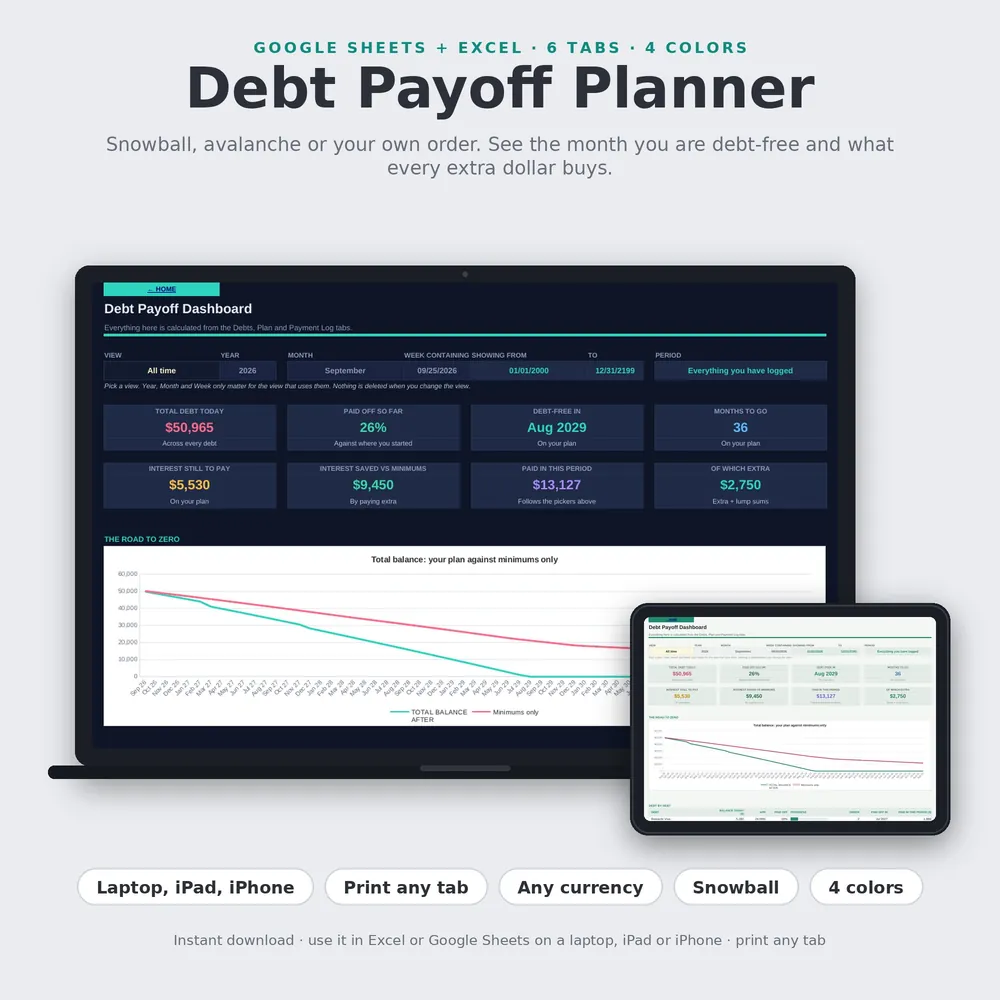
See your debt-free date, and what every extra dollar buys. Excel + Google Sheets, $12.99.