Can AI make me a monthly budget?
Yes. Give it your take-home pay and your bills and it builds a clear budget in a minute. You supply the numbers; it does the sorting and math.
01Why bot
- Sorting expenses into needs, wants and savings is exactly the kind of structured work AI does well.
- It explains every line, so you learn why the budget looks the way it does.
- You can ask for three versions (tight, normal, relaxed) and compare them.
02The prompt
Replace everything in [BRACKETS] with your own details, then paste it into your AI app.
You are a practical budgeting coach for regular people, not a financial advisor.

My monthly take-home pay: [AMOUNT]
My fixed bills (name and amount): [LIST]
My usual variable spending (groceries, gas, eating out, etc.): [LIST OR "not sure"]
My goal: [e.g. save $300 a month, pay off a credit card]

Build me a monthly budget.
Rules:
- Use only the numbers I gave you. If something is missing, ask me before guessing.
- Show the math. Totals MUST add up to my take-home pay.
- Flag any category where I'm spending more than typical and say why it matters.
Output: a table (Category | Amount | % of pay), then 3 short tips specific to my numbers.
03Steps
- Fill in the brackets with your real numbers.
- Paste it into the AI app and answer any follow-up questions.
- Check the totals yourself before you rely on them.
04What can go wrong
- AI can make arithmetic slips. Re-add the totals.
- Don't paste account numbers or passwords. Amounts are enough.
05What to use
06Our test runs
2 runs, each with a different made-up sample. 2 of 2 passed every check.
The made-up sample:
[AMOUNT]$4,800[LIST]Rent: $1,500; Electricity: $120; Internet: $60; Car payment: $350; Health insurance: $250[LIST OR "not sure"]Groceries: $500; Gas: $150; Eating out: $300; Entertainment: $200; Miscellaneous: $100[e.g. save $300 a month, pay off a credit card]Save $400 a month to build an emergency fund
- Use only the numbers provided
- Show the math
- Totals must add up to take-home pay
- Flag overspending categories with explanation
- Output table then 3 short tips
- Didn't make up details we never gave it
What came back (excerpt):
Since your take-home pay is $4,800, you have $4,800 - $3,930 = $870 left over. Here's your monthly budget table:
Read the full answer
To build your monthly budget, I'll start by calculating your total fixed bills and variable spending.

Fixed bills:
$1,500 (Rent) + $120 (Electricity) + $60 (Internet) + $350 (Car payment) + $250 (Health insurance) = $2,280

Variable spending:
$500 (Groceries) + $150 (Gas) + $300 (Eating out) + $200 (Entertainment) + $100 (Miscellaneous) = $1,250

Total fixed bills and variable spending:
$2,280 (Fixed bills) + $1,250 (Variable spending) = $3,530

You want to save $400 a month for your emergency fund.
So, your total monthly budget will be:
$3,530 (Fixed bills and variable spending) + $400 (Savings) = $3,930

Since your take-home pay is $4,800, you have $4,800 - $3,930 = $870 left over.

Here's your monthly budget table:

| Category | Amount | % of pay |
| --- | --- | --- |
| Rent | $1,500 | 31.3% |
| Electricity | $120 | 2.5% |
| Internet | $60 | 1.3% |
| Car payment | $350 | 7.3% |
| Health insurance | $250 | 5.2% |
| Groceries | $500 | 10.4% |
| Gas | $150 | 3.1% |
| Eating out | $300 | 6.3% |
| Entertainment | $200 | 4.2% |
| Miscellaneous | $100 | 2.1% |
| Savings | $400 | 8.3% |
| Left over | $870 | 18.1% |

Flagged category: Eating out ($300) - This might be higher than typical because the general guideline is to spend no more than 3-5% of your income on dining out. You're spending 6.3% of your income on eating out, which could be an area to cut back on to allocate more funds to savings or other priorities.

Tips:
1. Consider reducing your eating out expenses to free up more money for savings or other categories.
2. You have $870 left over each month, which could be used to increase your emergency fund savings or tackle other financial goals.
3. Review your car payment and insurance costs to ensure you're getting the best rates, as these expenses can add up quickly and might be negotiable.
Check that the flagged category truly exceeds typical spending guidelines.
The made-up sample (a messier one):
[AMOUNT]$3,750[LIST]Rent $1,200, Car payment $350, Internet $65, Cell phone $80, Health insurance $150, Student loan $200[LIST OR "not sure"]Groceries $380, Gas $130, Eating out $210, Entertainment $115, Miscellaneous $90[e.g. save $300 a month, pay off a credit card]Save $400 a month for an emergency fund and pay off $1,200 credit‑card balance
- Use only the numbers I gave you
- Show the math
- Totals must add up to take‑home pay
- Flag any category spending more than typical
- Didn't make up details we never gave it
What came back (excerpt):
To build your monthly budget, I'll start by calculating your total fixed bills and variable spending.
Read the full answer
To build your monthly budget, I'll start by calculating your total fixed bills and variable spending.

Fixed bills:
Rent: $1,200
Car payment: $350
Internet: $65
Cell phone: $80
Health insurance: $150
Student loan: $200
Total fixed bills: $1,200 + $350 + $65 + $80 + $150 + $200 = $2,045

Variable spending:
Groceries: $380
Gas: $130
Eating out: $210
Entertainment: $115
Miscellaneous: $90
Total variable spending: $380 + $130 + $210 + $115 + $90 = $925

You want to save $400 for an emergency fund and pay off $1,200 credit-card balance. To make this work, let's assume you'll pay a portion of the credit-card balance each month. Since you didn't specify the monthly payment, I'll calculate the total amount you have available for savings and debt repayment.

Total take-home pay: $3,750
Total fixed bills: $2,045
Total variable spending: $925
Total committed expenses: $2,045 + $925 = $2,970
Available for savings and debt repayment: $3,750 - $2,970 = $780

Since you want to save $400 for an emergency fund, you'll have $780 - $400 = $380 left for credit-card debt repayment.

Here's your monthly budget:

| Category | Amount | % of pay |
| --- | --- | --- |
| Rent | $1,200 | 32.0% |
| Car payment | $350 | 9.3% |
| Internet | $65 | 1.7% |
| Cell phone | $80 | 2.1% |
| Health insurance | $150 | 4.0% |
| Student loan | $200 | 5.3% |
| Groceries | $380 | 10.1% |
| Gas | $130 | 3.5% |
| Eating out | $210 | 5.6% |
| Entertainment | $115 | 3.1% |
| Miscellaneous | $90 | 2.4% |
| Emergency fund | $400 | 10.7% |
| Credit-card debt repayment | $380 | 10.1% |

Flagged categories:
- Eating out: $210 (5.6% of pay) might be considered high, as it's a significant portion of your variable spending. Reducing this amount could free up more money for savings and debt repayment.

Tips:
1. Consider reducing your eating out expenses to allocate more funds towards your emergency fund and credit-card debt repayment.
2. You're doing well on saving $400 for your emergency fund, which is a significant portion of your take-home pay.
3. Since you have $380 available for credit-card debt repayment, you might want to explore ways to pay off the $1,200 balance more aggressively, such as cutting back on other expenses or increasing your income.
Ensure no numbers are invented beyond the supplied data.
How each run works: we fill the prompt with a made-up sample, run it once in Llama 3.3 70B, and GPT-OSS 120B grades the answer against the prompt's own rules. Word limits are counted by code, and every quote flagged as made up is checked against the full answer. Your results can differ. How we test.
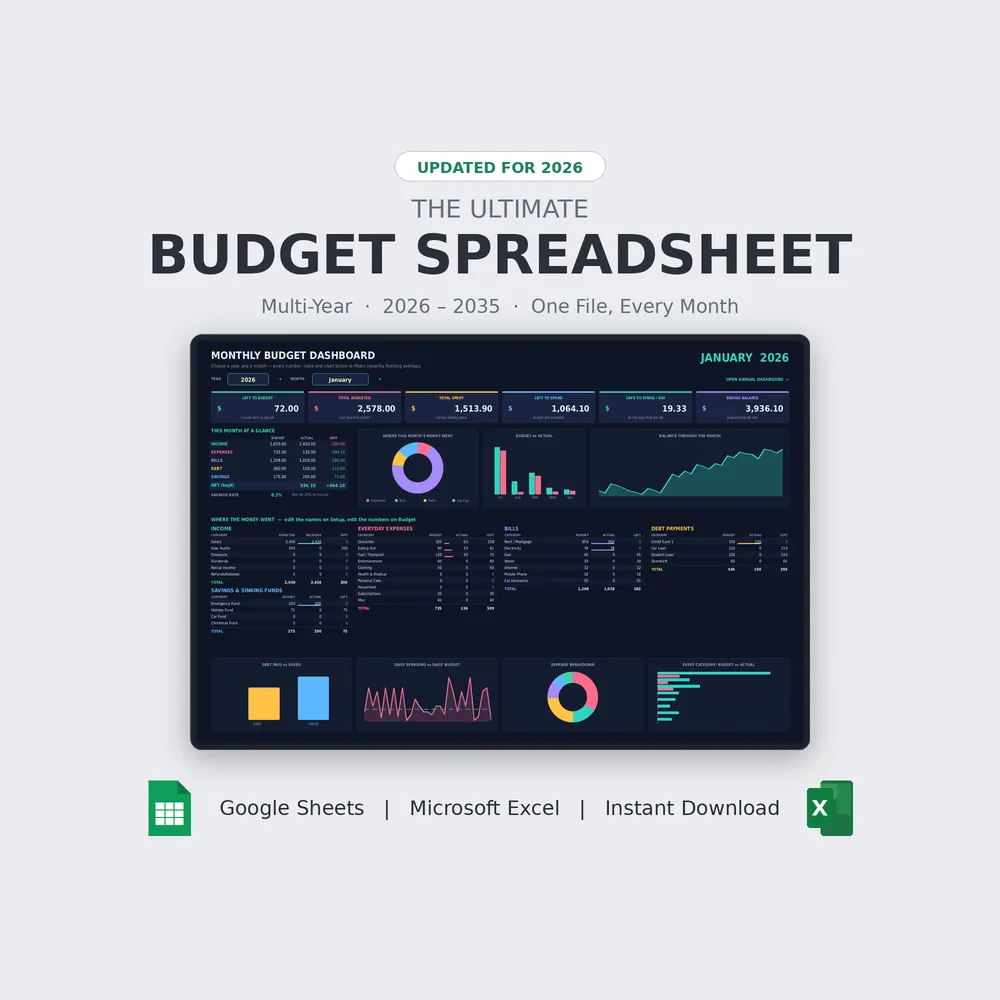
Every month, every year, in one file (2026 to 2035). Excel + Google Sheets, $19.99.