Can AI plan my emergency fund?
Yes. From your essential monthly costs and what you can save, it sets a target, a monthly amount and a timeline, and shows where the money could come from.
01Why bot
- The math is simple and AI shows each step.
- It separates essentials from nice-to-haves to set a realistic target.
- It turns a vague goal into a monthly number.
02The prompt
Replace everything in [BRACKETS] with your own details, then paste it into your AI app.
You are a practical money coach, not a financial advisor.

My essential monthly costs: [RENT, FOOD, UTILITIES, TRANSPORT, MINIMUM DEBT PAYMENTS]
What I have saved now: [AMOUNT]
What I can save per month: [AMOUNT]

Your task: plan my emergency fund.

Rules:
- MUST set targets for 1, 3 and 6 months of essentials and show the math.
- MUST show how many months each target takes at my savings rate.
- NEVER recommend specific banks or investments.

Give me: a targets table, the timeline, and 3 ideas to speed it up based on my numbers.
03Steps
- Add up only essential costs.
- Run the prompt.
- Set up an automatic transfer on payday.
04What can go wrong
- Re-check the math.
- Keep the fund somewhere easy to reach but separate from spending money.
05What to use
06Our test runs
2 runs, each with a different made-up sample. 2 of 2 passed every check.
The made-up sample:
[RENT, FOOD, UTILITIES, TRANSPORT, MINIMUM DEBT PAYMENTS]RENT: $1,200, FOOD: $350, UTILITIES: $150, TRANSPORT: $120, MINIMUM DEBT PAYMENTS: $200[AMOUNT]Saved now: $3,500; Monthly savings: $500
- Set targets for 1, 3, and 6 months of essentials with math
- Show how many months each target takes at my savings rate
- Never recommend specific banks or investments
- Provide a targets table, timeline, and 3 speed‑up ideas
- Didn't make up details we never gave it
What came back (excerpt):
To plan your emergency fund, we'll first calculate the targets for 1, 3, and 6 months of essential expenses.
Read the full answer
To plan your emergency fund, we'll first calculate the targets for 1, 3, and 6 months of essential expenses. Your essential monthly costs are:

- RENT: $1,200
- FOOD: $350
- UTILITIES: $150
- TRANSPORT: $120
- MINIMUM DEBT PAYMENTS: $200

Total monthly essential costs = $1,200 + $350 + $150 + $120 + $200 = $2,020

### Targets Table

| Target        | Amount      |
|---------------|-------------|
| 1 Month       | $2,020      |
| 3 Months      | $6,060      |
| 6 Months      | $12,120     |

### Timeline to Reach Each Target

Given your monthly savings rate is $500, let's calculate how many months it will take to reach each target:

1. **1 Month Target**: $2,020 / $500 = 4.04 months
2. **3 Months Target**: $6,060 / $500 = 12.12 months
3. **6 Months Target**: $12,120 / $500 = 24.24 months

### Ideas to Speed Up Reaching Your Emergency Fund Targets

1. **Increase Income**: Look for ways to increase your monthly income, such as taking on a part-time job, freelancing, or selling items you no longer need. Even an extra $100-$200 per month can significantly reduce the time it takes to reach your targets.

2. **Reduce Expenses**: While you've listed your essential expenses, there might be areas where you can cut back and allocate more funds towards savings. Review your budget carefully to identify any potential savings.

3. **Use Windfalls**: Plan to use any windfalls, such as tax refunds, bonuses, or gifts, towards your emergency fund. These lump sums can drastically reduce the number of months it takes to reach your savings goals.

Remember, building an emergency fund takes time and discipline, but it's a crucial step in securing your financial stability.
Watch for any prohibited bank or investment suggestions.
The made-up sample (a messier one):
[RENT, FOOD, UTILITIES, TRANSPORT, MINIMUM DEBT PAYMENTS]Rent $1,200, Food $340, Utilities $175 (electric, water, internet), Transport $115 (gas & occasional rideshare), Minimum debt payments $260 (credit card $150 + student loan $110)[AMOUNT]Saved so far: $3,200. I can consistently put aside roughly $450 per month toward the fund.
- Set targets for 1, 3 and 6 months of essentials and show the math
- Show how many months each target takes at my savings rate
- Never recommend specific banks or investments
- Give a targets table, the timeline, and 3 ideas to speed it up
- Didn't make up details we never gave it
What came back (excerpt):
To plan your emergency fund, we first need to calculate your monthly essential costs.
Read the full answer
To plan your emergency fund, we first need to calculate your monthly essential costs. Based on the information provided:

- Rent: $1,200
- Food: $340
- Utilities: $175
- Transport: $115
- Minimum debt payments: $260

Total monthly essential costs = $1,200 + $340 + $175 + $115 + $260 = $2,090

Now, let's calculate the targets for 1, 3, and 6 months of essentials:

| Target | Amount |
| --- | --- |
| 1 Month | $2,090 |
| 3 Months | $2,090 * 3 = $6,270 |
| 6 Months | $2,090 * 6 = $12,540 |

To determine how many months it will take to reach each target at your savings rate of $450 per month, we'll use the following calculations:

1. Current savings: $3,200
2. Monthly savings: $450

- Time to reach 1 month target: Since you already have $3,200, which is more than the $2,090 needed for 1 month, you've already reached this target.
- Time to reach 3 months target: You need $6,270 - $3,200 = $3,070 more. At $450/month, it will take $3,070 / $450 = 6.82 months to reach this target.
- Time to reach 6 months target: You need $12,540 - $3,200 = $9,340 more. At $450/month, it will take $9,340 / $450 = 20.76 months to reach this target.

Here's a summary of the targets and the time it will take to reach them:

| Target | Amount Needed | Months to Reach |
| --- | --- | --- |
| 1 Month | Already reached | 0 |
| 3 Months | $3,070 | 6.82 months |
| 6 Months | $9,340 | 20.76 months |

To speed up reaching your emergency fund targets, consider the following ideas:

1. **Increase Income**: Look for ways to increase your income, such as taking on a part-time job, freelancing, or selling items you no longer need. Even a small increase can significantly reduce the time it takes to reach your targets.

2. **Reduce Expenses**: Review your budget to see where you can cut back on non-essential spending. Directing these savings towards your emergency fund can help you reach your goals faster.

3. **Optimize Debt Payments**: While you're saving, also consider strategies to reduce your debt, especially high-interest debt like credit cards. Paying off debts can free up more money in your budget for savings. However, it's essential to balance debt repayment with building your emergency fund to avoid going further into debt when unexpected expenses arise.

Remember, building an emergency fund is a process, and consistency is key. Regularly review your budget and savings progress to make adjustments as needed.
The response meets all required elements and avoids prohibited bank recommendations.
How each run works: we fill the prompt with a made-up sample, run it once in Llama 3.3 70B, and GPT-OSS 120B grades the answer against the prompt's own rules. Word limits are counted by code, and every quote flagged as made up is checked against the full answer. Your results can differ. How we test.
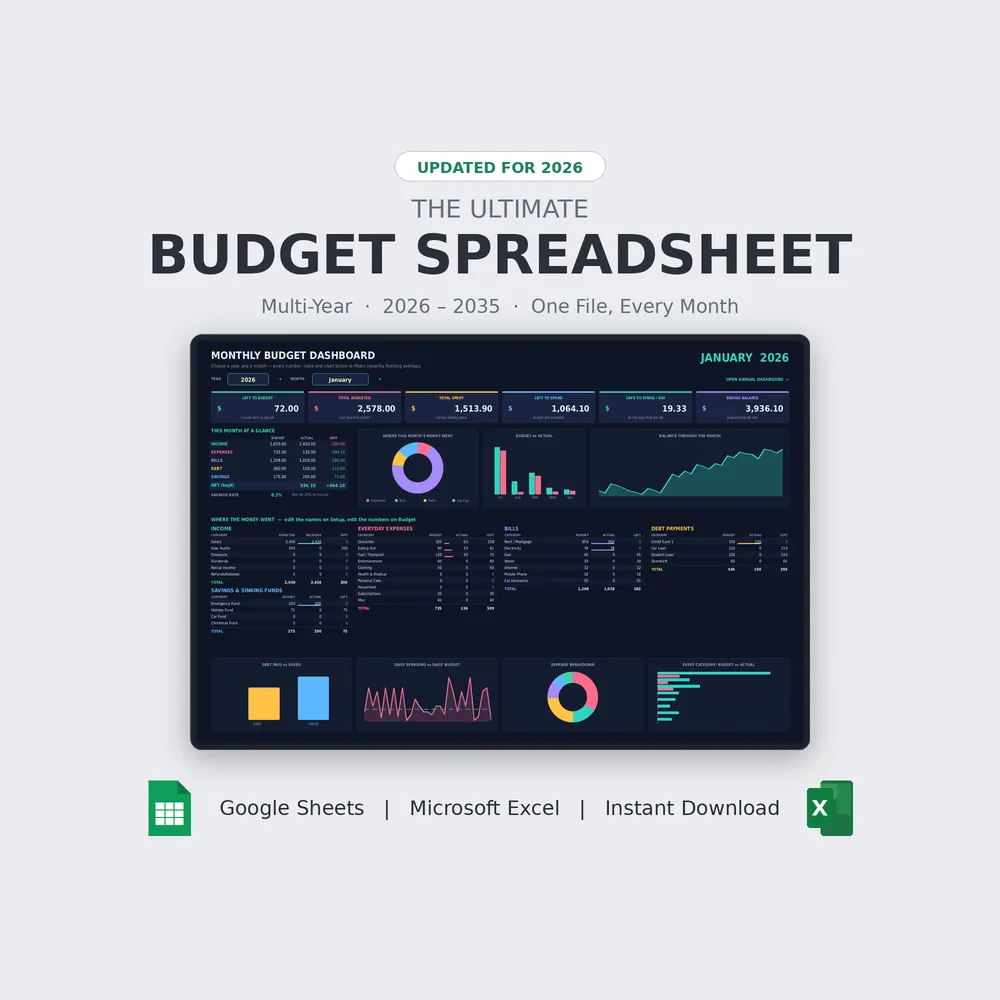
Every month, every year, in one file (2026 to 2035). Excel + Google Sheets, $19.99.